

Weego: From Bus Predictions in Dakar to a $1.1M Bet on Africa’s Mobility Future

If you’ve ever tried to get across a busy African city during peak hour, you know the drill:
three different transport options, zero coordination between them, and a lot of guesswork.
That chaos? That’s exactly where Weego started.
When Mandilakhe Somdle of AfricArena sat down with Saad Jittou, Founder & CEO of Weego, what unfolded wasn’t just a startup story, it was a masterclass in building infrastructure where none exists.
From Dakar Experiments to a Continental Vision
Weego didn’t begin as a grand mobility platform. It started with a simple, almost scrappy idea in Dakar: Can you predict when an informal bus will arrive?
Back then, there was no clear business model. Just curiosity, code, and a problem worth solving.
Saad and his co-founders built an early algorithm to track arrival times for informal buses, long before AI became a buzzword. The product wasn’t perfect, but people used it anyway. That was the first signal.
Then came the pivot.
When the World Stops, You Adapt
Just as Weego began gaining traction, COVID hit. Public transport slowed down globally, and for a mobility startup, that’s about as bad as it gets.
Instead of waiting it out, the team adapted.
A large enterprise approached them with a simple request:Can your tech improve how our employees commute?
That question led to WeegoLines, a B2B solution for employee transport.
Today, that pivot powers:
50+ companies
5 cities
Thousands of monthly rides
What started as a survival move became a core revenue engine.
The Bigger Play: One App to Move Them All
But Weego’s real ambition goes far beyond employee transport.
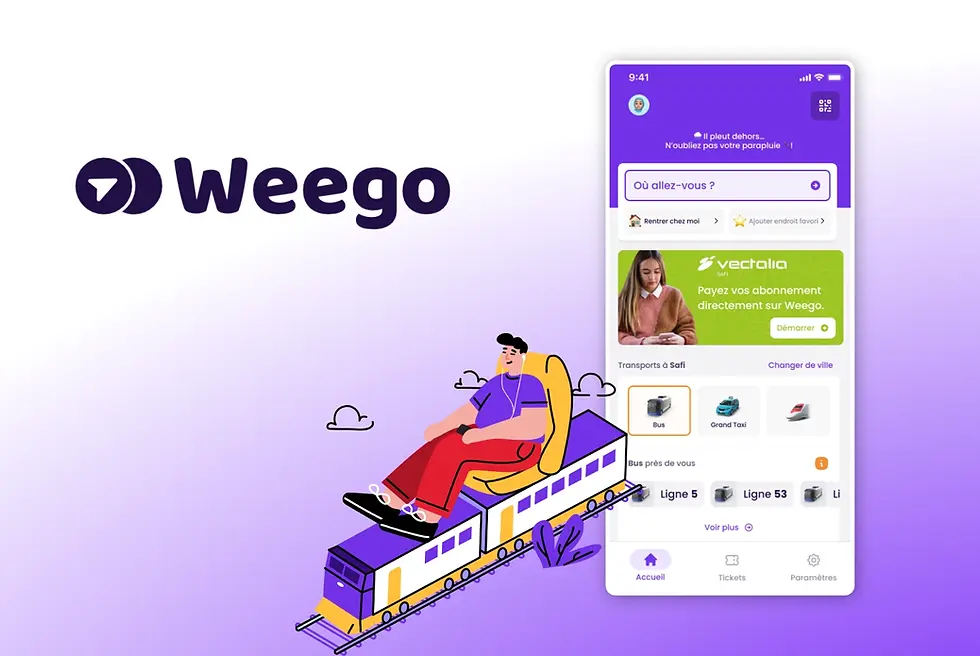
The vision is bold (and necessary): One platform that aggregates every mode of transport in a city, buses, trains, taxis, into a single, seamless experience.
One app. One payment system. One unified journey. Sounds simple. It’s not.
Building in a Data Desert
In many African cities, transport data doesn’t exist. No mapped routes. No reliable schedules. No digital infrastructure.
So Weego did what infrastructure companies do best: they built it themselves.
Volunteers mapped transport routes manually, A proprietary tracking engine (“Echo”) captures movement data in real time, APIs integrate with formal transport systems where available, Custom POS devices enable payments across vehicles, and It’s not just a tech platform. It’s a full-stack mobility layer, and that’s what makes it powerful.
A Business Model That Actually Works
Here’s where it gets interesting.
Weego doesn’t charge transport operators upfront.Instead, they take a 3–5% commission per ticket sold.
That means:
Zero barrier to entry for operators, Faster adoption, and Revenue scales with usage
In markets where friction kills deals, this model unlocks growth.
Traction, Growth, and a $1.1M Boost
Weego has now raised over $2 million in total funding, including a recent $1.1 million round.
But this raise didn’t come easy.
Mobility isn’t the trendiest sector right now. Investors are chasing AI, automation, and hype cycles. Weego had to do something different:
Prove the model works.
Live in multiple cities, Real users, Real revenue, and Real expansion roadmap
The new capital is being deployed with focus:
60% into technology and hiring engineers. Expanding to Abidjan, Accra, and Lisbon. Scaling both B2B and public transport products
This isn’t growth for headlines. It’s growth for infrastructure.
AfricArena: Where Visibility Meets Opportunity
Weego’s journey also intersects with the AfricArena ecosystem.
After pitching at AfricArena, the team:
Won Best Mobility Startup (2023)
Gained exposure to pan-African investors
Built relationships beyond their home market
At the time, their revenue was modest. But the visibility mattered.
Because in Africa, access isn’t always about proximity, it’s about platforms that bring the ecosystem together. And that’s where AfricArena plays its role.
The Founder’s Reality: “We Were Close to Dying Three Times”
Behind the traction and funding headlines lies a different story.
Saad was candid:
“We were near bankruptcy three times.”
That’s the part most people don’t see. The late nights, the uncertainty, the almost-ending moments. And yet, they kept going.
Not because it was easy, but because the problem was worth solving..
Advice to Founders: Build at Your Own Pace
When asked about advice, Saad pushed back on the idea of a “formula.”
Instead, he shared something more grounded:
Be patient, meaningful things take time, Don’t compare journeys, everyone starts differently, Focus on profitability, it buys you freedom, and Celebrate your own wins, even the small ones.
And perhaps most importantly:
“We are not in competition with anyone. Everyone should wait for their turn.”
The next phase is clear:
Scale city by city
Expand across Africa and beyond
Strengthen payments infrastructure
Build the operating system for urban mobility
Because the future of mobility in Africa isn’t just about moving people.
It’s about making movement predictable, accessible, and connected.
Want to Be Part of the Next Big Thing?
Whether you’re a startup founder looking to raise capital, a corporate ready to collaborate, or just someone who loves being in the room where Africa’s future happens, we’ve got a seat for you.
Apply to the AfricArise Program: pitch at one of our regional summits and get access to investors, partners, and accelerators across the continent.
Join us at the AfricArena Nairobi Summit 2026, happening 29–30 April, where Africa’s boldest founders, top investors, and ecosystem builders gather for two days of pure innovation energy.
Secure your super early bird tickets for Nairobi here: https://www.eventbrite.com/e/africarena-nairobi-summit-2026-tickets-1980540202059?aff=oddtdtcreator
Because in the AfricArena network, one connection can change everything.
Explore African startup stories at africarena.com
Learn more about Weego: www.weegolife.com


Comments